

P-DEF: How to Manage Heat in the Braking System

When it comes to high-performance brakes, heat is not a side effect: it is an integral part of how the braking system works.
During every braking event, the vehicle’s kinetic energy is converted primarily into thermal energy through friction between the brake disc and the pad. In motorsport, where decelerations are intense and closely repeated, temperatures can become extremely high.
The issue, however, is not simply that the brakes get hot. Discs and pads must reach and remain within a specific temperature window in order to work correctly.
The real challenge is controlling where that heat is transferred.
When Heat Becomes a Problem
Part of the energy generated during braking is dissipated by the disc, while another portion passes through the brake pad and its metal backing plate until it reaches the pistons and caliper.
The heat transfer path can be simplified as follows:
Disc → Brake Pad → Piston → Caliper
When temperatures become particularly high, the heat transferred to the caliper can also affect the hydraulic circuit.
This is where one of the most critical phenomena for a braking system can occur: vapour lock.
What Is Vapour Lock?
Brake fluid is responsible for transmitting pressure from the brake pedal to the caliper pistons.
Under normal conditions, it is practically incompressible. However, if it reaches excessively high temperatures, vapour can begin to form.
Unlike liquid, vapour bubbles are compressible.
The result can be a progressively longer or spongier brake pedal, because part of the pedal travel is used to compress the vapour rather than directly transferring pressure to the pistons.
For this reason, in racing braking systems, limiting heat transfer towards the caliper and brake fluid is a fundamental part of thermal management.
It Does Not Simply Mean “Cooling the Brakes”
A braking system should not be kept as cold as possible.
Racing brake pads, for example, are designed to operate within specific temperature windows. Excessive cooling can be just as counterproductive as pushing them beyond their intended operating range.
Thermal management therefore involves several aspects:
- brake disc ventilation;
- selection of the friction material;
- brake fluid characteristics;
- caliper design;
- thermal insulation between the different components.
And it is precisely this last aspect that P-DEF addresses.
P-DEF: A 1 mm Thermal Barrier
P-DEF – Pyroclast® Dynamic Energy Filter is an insulating shim developed by EVO Corse for racing applications.
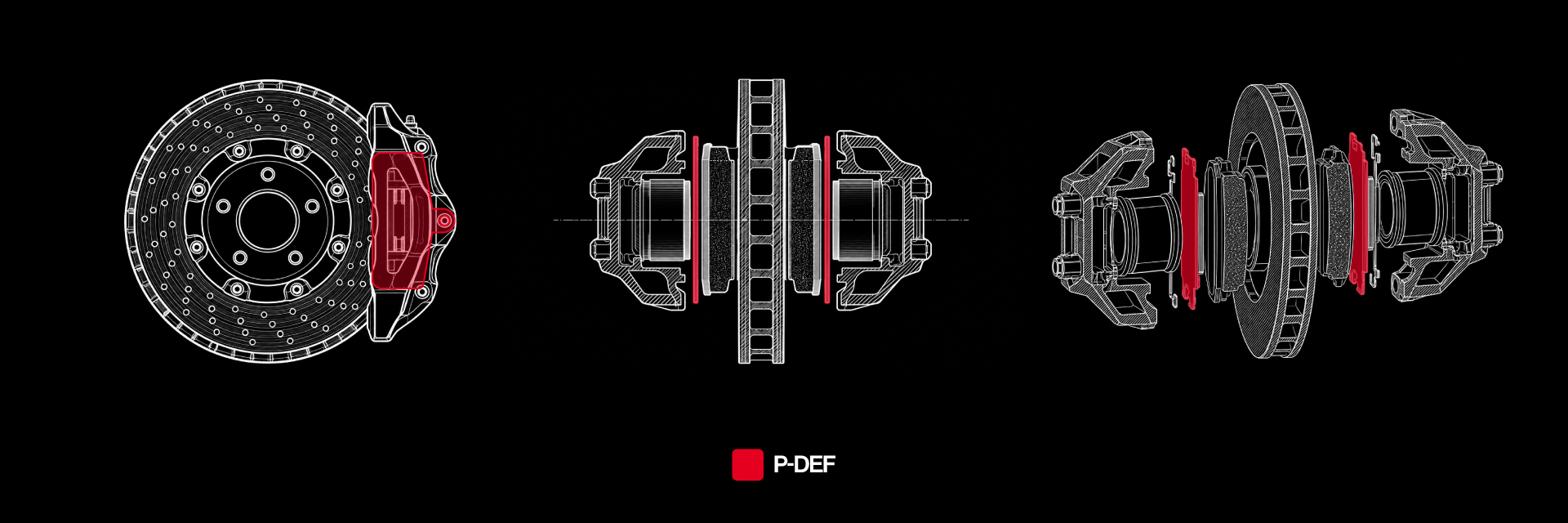
It is installed between the rear of the brake pad and the caliper piston.
Its purpose is not to directly cool the disc or brake pad, but to limit the transfer of thermal energy towards the pistons, caliper and hydraulic circuit.
The heat transfer path therefore becomes:
Disc → Brake Pad → P-DEF → Piston → Caliper
With a nominal thickness of just 1 mm, P-DEF creates a thermal barrier in one of the main areas through which heat is transferred from the brake pad to the caliper.
The Role of Pyroclast®
At the heart of P-DEF is Pyroclast® material.
The material has a declared thermal conductivity of 0.21 W/mK and can withstand prolonged operating temperatures of up to 620 °C.
Its low thermal conductivity limits the transfer of heat through the thickness of the shim, helping to reduce the thermal exposure of the pistons, caliper, seals and brake fluid.
The result is not a direct increase in braking power, but improved management of the energy generated during the most demanding braking conditions.
What Other Solutions Are Available?
Thermal insulation between the brake pad and caliper is not the only solution used in the industry.
Road brake pads often feature thin anti-noise shims, consisting of metal layers combined with elastomeric materials. Their primary purpose, however, is to reduce vibration and braking noise, rather than to create a true thermal barrier for racing applications.
In motorsport, titanium shims are also used. Compared with steel, titanium transfers significantly less heat and therefore already provides useful thermal insulation. However, it remains considerably more conductive than the material used in P-DEF: as a general reference, some titanium alloys have thermal conductivity values in the range of a few W/mK, compared with approximately 0.2 W/mK for Pyroclast®. Titanium also has a higher density — approximately 4.5 g/cm³ compared with around 2.2 g/cm³ — as well as a higher material cost.
Another solution is the use of caliper pistons with integrated ceramic insulating elements. This is a technically effective approach because the thermal barrier is incorporated directly into the caliper. However, the insulation mainly affects the piston contact areas, while a P-DEF shim can cover a much larger portion of the rear surface of the brake pad.
These solutions are therefore based on the same general principle: limiting the heat path towards the caliper, but applying that principle in different ways.
Can the Driver Feel P-DEF Through the Pedal?
Adding an element between the piston and brake pad might suggest that brake pedal feel could change.
With P-DEF, however, the material’s high compressive strength allows the force exerted by the pistons to be transferred to the brake pad without introducing perceptible deformation during braking.
Tests were also carried out blind, without informing the driver beforehand that the shims had been installed, and no significant changes in brake pedal feedback were reported.
This means that P-DEF can contribute to thermal management without requiring the driver to alter their braking technique or usual pedal reference.
And What Happens When the Brakes Are Cold?
The insulation also works in the opposite direction.
By limiting one of the paths through which the brake pad dissipates heat towards the caliper, P-DEF can help the friction material remain within its operating temperature window more easily.
This can be particularly useful in conditions where the brakes start from relatively low temperatures.
P-DEF does not generate heat: its operation is completely passive and relies entirely on the insulating properties of the material.
A Component Designed for Racing
In motorsport, achieving strong deceleration is not enough.
The braking system must remain consistent and predictable even after repeated braking events and under particularly severe thermal conditions.
P-DEF was developed specifically to address this aspect: managing heat transfer between the brake pad and caliper without altering the fundamental operating principle of the braking system.
The shims are manufactured with specific geometries for different brake pads and braking systems, which means compatibility must always be checked before installation.
P-DEF can also typically be reused for approximately three sets of brake pads, depending on operating conditions and the condition of the material.
In Summary
Heat is inevitable in a high-performance braking system.
What makes the difference is how that heat is managed.
P-DEF acts at a precise point within the system, creating a thermal barrier between the brake pad and the piston and helping to limit heat transfer towards the caliper and hydraulic circuit.
A solution that is simple in form, yet developed to address a very real issue in racing applications.
FAQ
Why Does the Brake Pedal Feel Spongy When the Brakes Get Very Hot?
One possible cause is the formation of vapour inside the hydraulic circuit. When the brake pedal is pressed, part of its travel is used to compress the vapour bubbles instead of directly transferring pressure to the pistons.
What Are Brake Insulating Shims Used For?
They are used to limit heat transfer between the brake pad and the caliper pistons, helping to thermally protect the caliper, brake fluid and hydraulic system components.
Where Is P-DEF Installed?
P-DEF is positioned between the back of the brake pad and the caliper piston.
Is P-DEF Compatible With Any Brake Pad?
No. The shims are manufactured with specific geometries, and compatibility must be checked according to the brake pad and braking system.
Can P-DEF Be Reused?
P-DEF can typically be reused for approximately three sets of brake pads, depending on the condition of the material and the type of use.