

Wheel Offset Explained: What ET Means and What Changes When It Varies

ET35, ET20, ET0: these values often appear in wheel specifications, but what do they actually mean?
ET, commonly referred to as wheel offset, is one of the key parameters that determines how a wheel sits on a vehicle. It is not simply a matter of how far a wheel appears to stick out: offset affects the available clearance inside the wheel arch and, together with the other wheel dimensions, its position relative to the vehicle’s suspension and steering geometry.
Here is what ET means and what happens when it changes.
What is wheel offset?
The abbreviation ET comes from the German term Einpresstiefe. In English, it is normally referred to as offset.
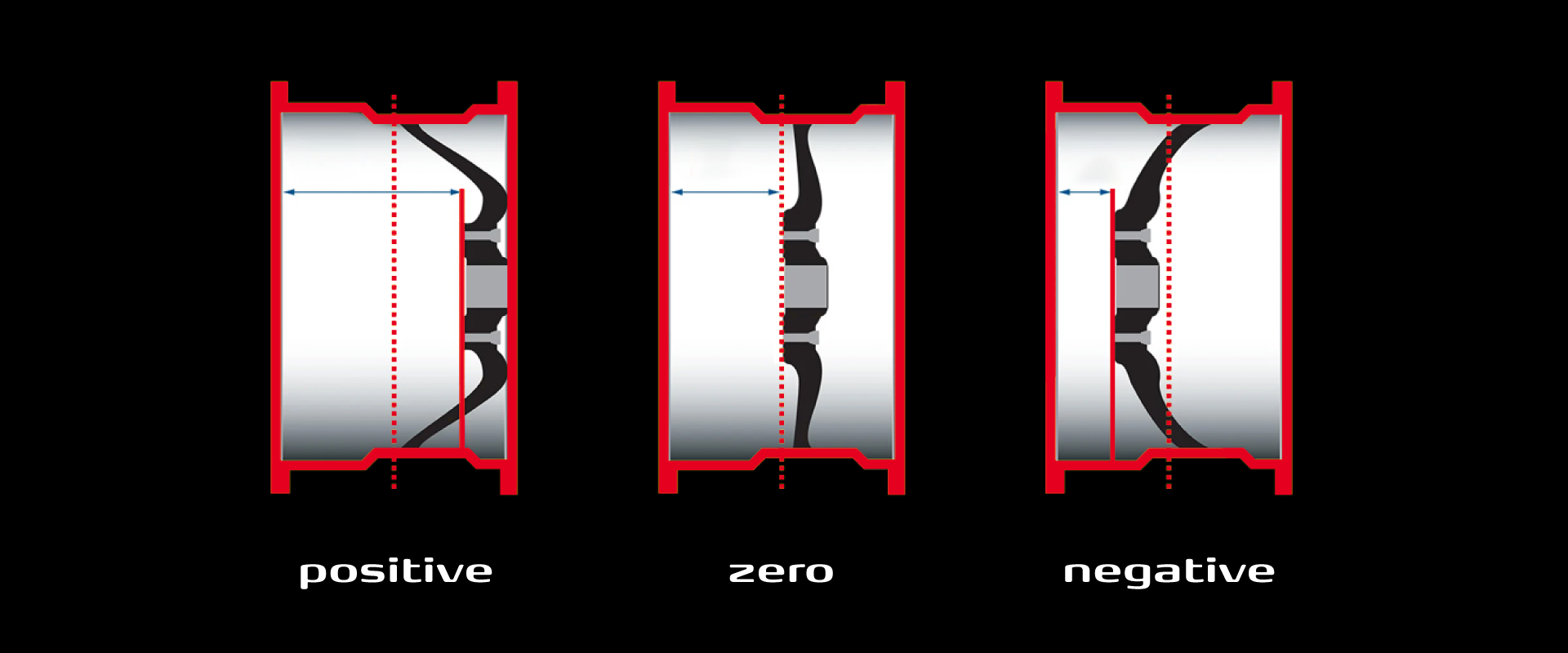
Measured in millimetres, it represents the distance between:
- the centreline of the wheel rim;
- the wheel mounting surface that contacts the hub.
In altre parole, stabilisce dove si trova il piano di fissaggio del cerchio rispetto al suo centro.
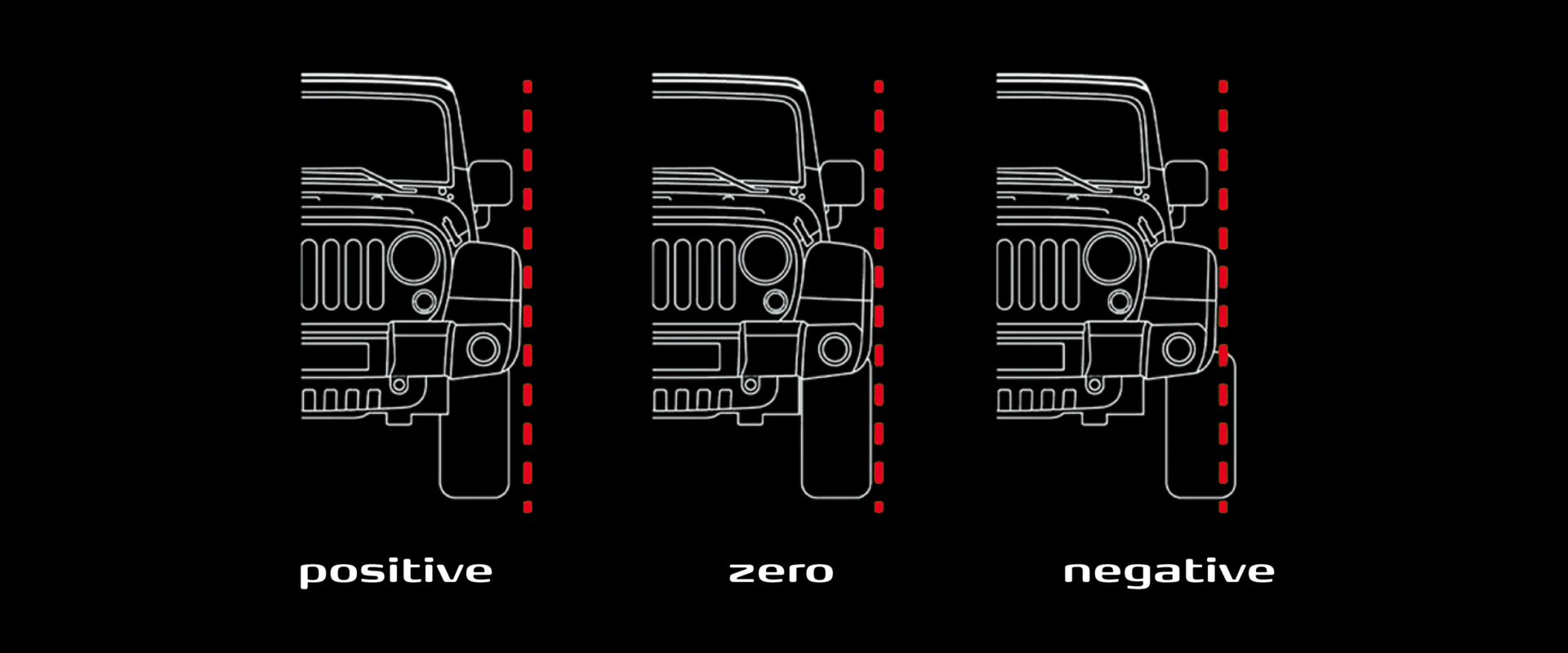
This creates three possible configurations:
| Type | Mounting surface position |
| Positive offset | The mounting surface is positioned towards the outside of the wheel relative to its centreline |
| Zero offset | The mounting surface coincides with the wheel centreline |
| Negative offset | The mounting surface is positioned towards the inside of the wheel relative to its centreline |
Most modern passenger vehicles use positive offset values, while values close to zero or negative offsets can be found in certain specific applications, including some off-road configurations.
What happens when offset is reduced?
For wheels of the same width, reducing the ET value moves the entire wheel further towards the outside of the vehicle.
For example, comparing two wheels with the same width:
ET42 → ET37
the ET37 wheel will sit 5 mm further outwards.
If the same change is applied to both wheels on one axle, the distance between their centreplanes increases by a total of 10 mm.
A lower offset can therefore provide additional clearance on the inner side of the wheel, but at the same time reduces the available space towards the wheel arch and bodywork.
What happens when offset is increased?
The opposite happens when the offset value is increased.
Again, assuming the wheel width remains unchanged, a higher ET moves the wheel further inwards.
This creates more clearance towards the outer edge of the wheel arch, but reduces the available space towards suspension components, control arms and other elements located on the inner side of the wheel.
The correct offset must therefore allow the wheel and tyre to operate without interference throughout the vehicle’s intended range of movement, including steering, suspension compression, load and dynamic driving conditions.
Wheel width and offset must be considered together
This is one of the most important points when discussing ET.
Saying that “ET35 sticks out more than ET45” is correct only when comparing wheels of the same width.
If the rim width also changes, the position of both the inner and outer edges of the wheel changes.
A wider wheel with the same offset extends further both inwards and outwards. This means that when rim width changes, a different offset may also be required to maintain the intended wheel position and clearances.
Diameter, width and offset should therefore never be considered completely independently from one another. They are all part of the same wheel fitment.
Is offset only about how far a wheel sticks out?
No.
Its visual effect is simply the most obvious consequence.
The position of the wheel also contributes to determining the vehicle’s track width and the position of the tyre relative to the suspension and steering geometry.
Significant changes in offset can, for example, alter the scrub radius: the distance at road level between the centre of the tyre contact patch and the point where the steering axis intersects the ground.
Changing this relationship can affect steering feedback, the vehicle’s response to road irregularities and its behaviour under certain braking or acceleration conditions.
This does not mean that a higher or lower offset is automatically better. The correct value depends on the geometry and application for which the wheel and vehicle have been designed.
Offset and loads on hubs and suspension components
Moving a wheel significantly further outwards also changes the lever arm through which forces generated at the tyre are transmitted to the wheel hub and suspension.
Large deviations from the intended configuration can therefore alter the loads acting on wheel bearings, joints, bushings and other suspension components.
For this reason, offset should not be selected purely to achieve a particular visual position within the wheel arch.
It is a functional dimension of the complete wheel and suspension system.
Offset and brake clearance: they are not the same thing
Another common misconception is that knowing the ET is enough to determine whether a wheel will clear a particular brake caliper.
It is not.
Offset determines the wheel’s position relative to the hub, while brake clearance also depends on factors such as:
- spoke geometry and profile;
- inner rim profile;
- mounting pad design;
- brake disc and caliper dimensions;
- the overall wheel architecture.
This means that two wheels with the same diameter, width and offset can offer completely different levels of brake clearance. ET is therefore an important part of wheel fitment, but it cannot be used alone to determine brake compatibility.
Does a lower ET always mean a more concave wheel?
No.
A lower offset may provide greater design freedom for certain wheel geometries, but it does not automatically create a deeper or more concave wheel design.
The final shape depends on several factors, including wheel width, spoke design, structural requirements, brake clearance and the overall engineering of the wheel. Offset describes a geometric dimension, not the styling of the wheel.
Can you use a different offset from the original wheel?
Yes, in certain applications.
An aftermarket wheel does not necessarily need to have exactly the same offset as the original wheel. A different rim width, for example, may require a different ET in order to achieve the correct positioning.
However, this does not mean that any offset can be used.
The complete wheel configuration must be suitable for the vehicle and comply with the relevant specifications and approvals. Clearance towards suspension components, bodywork, tyres and the braking system must also be verified.
Offset should therefore be considered as part of the complete wheel fitment, rather than as an isolated specification.
In Summary
ET, or wheel offset, defines the position of the wheel mounting surface in relation to the centreline of the rim.
For wheels of the same width:
Lower ET → wheel moves further outwards
Higher ET → wheel moves further inwards
But ET alone is not enough to determine whether a wheel is suitable for a vehicle.
Rim width, tyre dimensions, suspension geometry, wheel arch clearance, braking system and intended use all need to be considered together when defining the correct configuration.
Because in wheel design, even a few millimetres have a purpose.
FAQ
What does ET35 mean on a wheel?
ET35 means that the wheel mounting surface is positioned 35 mm away from the centreline of the rim, creating a positive offset of 35 mm.
Does a lower ET make the wheel stick out further?
Yes, provided that the wheel width remains the same.
For example, changing from ET40 to ET30 moves the wheel 10 mm further outwards.
Does a wider wheel with the same ET remain in the same position?
Its centreline remains in the same position relative to the hub, but the additional width increases the wheel’s dimensions both towards the inside and outside.
This is why width and offset must always be considered together when evaluating fitment.
Does offset affect track width?
Yes.
For wheels of the same width, reducing the ET moves them further outwards and increases the track width. Increasing ET has the opposite effect.
Does a lower ET improve handling?
Not necessarily.
A wider track is only one consequence of changing offset. The modification can also affect steering geometry and the loads transmitted through suspension and hub components.
There is therefore no general rule that “lower ET means better handling.”
Can ET tell me whether a wheel will clear the brake caliper?
No.
Offset is only one of the relevant parameters. Brake clearance also depends on the internal wheel geometry, spoke profile, mounting pad and the dimensions and position of the brake disc and caliper.
Can I use a different ET from the original wheel?
It depends on the specific application.
A wheel designed or approved for a particular vehicle can use a different offset from the original configuration, especially when other parameters such as rim width also change.
The complete fitment and the applicable technical requirements must always be verified before installation.
Find the correct wheel configuration for your vehicle
Diameter and wheel design are only part of the equation. Width, offset and application need to work together.
Explore the applications available across the EVO Corse range or contact us to identify the correct wheel configuration for your vehicle and intended use.