

Wheel PCD: What It Is, What It Means and Why It Matters for Compatibility

4×100, 5×112, 5×114,3, 6×139,7
These codes appear constantly in wheel specifications. At first glance, they may look like little more than a series of numbers, but they identify one of the key parameters required to correctly fit a wheel to a vehicle: the PCD.
PCD stands for Pitch Circle Diameter and describes the arrangement of the holes used to secure the wheel to the hub.
Let’s take a closer look at what it means, how to read it and why knowing the PCD alone is not enough to determine whether a wheel is compatible with a vehicle.
What is wheel PCD?
PCD – Pitch Circle Diameter is the diameter, usually expressed in millimetres, of the imaginary circle that passes through the centre of the wheel’s mounting holes.
The number of mounting holes is always specified together with the diameter of this circle.
Let’s take a common example:
5×114,3
This means:
5 = number of mounting holes
114.3 mm = diameter of the circle on which the centres of the five holes are positioned
The same principle applies to configurations such as:
4×100 → four holes positioned on a 100 mm diameter circle
5×112 → five holes positioned on a 112 mm diameter circle
6×139.7 → six holes positioned on a 139.7 mm diameter circle
This configuration is also commonly referred to as the bolt pattern or bolt circle.
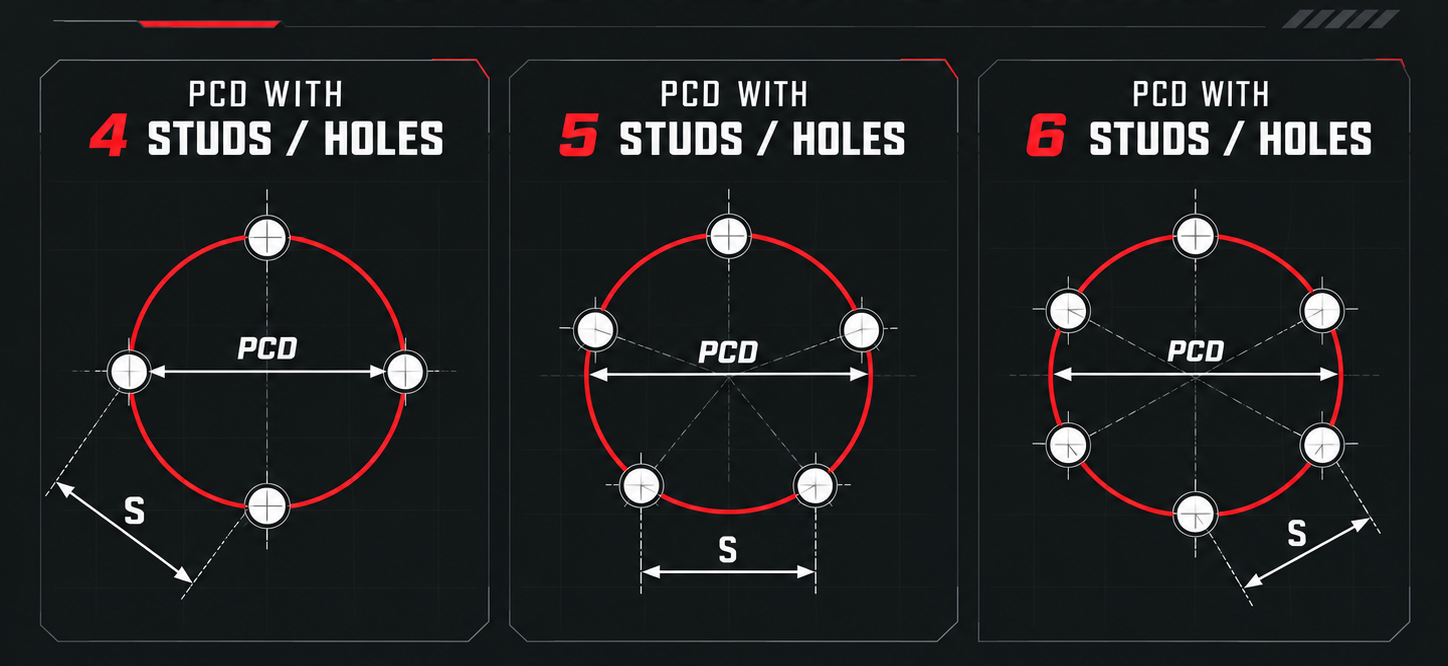
Are PCD and bolt spacing the same thing?
In everyday language, PCD is sometimes described simply as the spacing between the wheel mounting holes.
While understandable, this can be misleading.
The PCD does not necessarily represent the direct distance between two holes. It represents the diameter of the imaginary circle on which all the mounting points are positioned.
This is particularly clear on five-hole wheels, where there is no mounting hole positioned exactly opposite another one through the centre of the wheel.
It is therefore more accurate to think of PCD as the diameter of the bolt circle, rather than simply as the distance between two bolts.
How is PCD measured?
The method depends on the number of mounting holes.
Wheels with an even number of mounting holes
With configurations such as 4, 6 or 8 holes, the principle is relatively straightforward.
Since there are mounting holes positioned directly opposite each other, the PCD can be determined by measuring the distance from the centre of one hole to the centre of the opposite hole.
This distance corresponds directly to the diameter of the bolt circle.
On a 4×100 wheel, for example, the centres of two opposite holes are 100 mm apart.
Five-hole wheels
With five mounting holes, the situation is different because there is no hole positioned exactly opposite another one.
There are several geometric methods for calculating the PCD from the distance between the holes, but manual measurements can easily lead to inaccurate results.
Some five-hole PCD configurations are also very close in size, meaning that even a small measuring error can lead to the wrong bolt pattern being identified. For an accurate check, it is therefore preferable to use a PCD gauge or dedicated measuring tool, or to refer to the certified technical specifications of the vehicle and wheel.
For a real-world application, particularly on wheels intended for motorsport or demanding use, a manual measurement should never replace the verification of the correct technical data.
Be careful with very similar PCDs
A difference of just a few millimetres may appear insignificant when looking at a wheel, but it is not.
Configurations such as:
5×110
5×112
5×114,3
5×115
are all different bolt patterns.
Having the same number of mounting holes and numerically similar PCD values does not make them interchangeable. The wheel must use the mounting configuration specified for that particular application.This is especially important with five-hole configurations, where some bolt patterns can be difficult to distinguish accurately through manual measurement alone.
Why do some PCDs have decimal values?
Values such as 114.3 mm, 120.65 mm, 139.7 mm or 165.1 mm may look unusual compared with rounder measurements such as 100, 110 or 120 mm.
In many cases, they are the result of dimensions originally specified in inches and later converted into millimetres.
For example:
114,3 mm = 4,5″
127 mm = 5″
139,7 mm = 5,5″
165,1 mm = 6,5″
This is why the same bolt pattern may be referred to, particularly in the North American market, as either 5×114.3 or 5×4.5″.
Why is PCD so important?
The PCD geometrically defines the position of the mounting points through which the wheel is secured to the hub.
The holes in the wheel and the vehicle’s mounting system must therefore correspond to the intended configuration.
However, there is one important point to understand:
Having the same PCD does not automatically mean that two wheels are interchangeable.
PCD is only one of the parameters that determine wheel fitment.
In technical wheel documentation, PCD, offset, centre bore and mounting hardware specifications are treated as separate parameters. A wheel can therefore be produced with different PCDs combined with different centre bore sizes, offsets and mounting systems depending on the intended vehicle and application.
PCD and centre bore: what is the difference?
They are two completely different measurements.
The PCD describes the arrangement of the wheel mounting holes.
The centre bore, or CB, is the diameter of the central opening in the wheel that interfaces with the centre of the vehicle hub.
For example, a wheel could have:
PCD: 5×112
Centre Bore: 66.6 mm
These are two independent specifications and must be considered separately when checking wheel fitment.
Are PCD and ET related?
No. They describe two different geometric characteristics of the wheel.
The PCD concerns the arrangement of the mounting points.
The ET, or offset, describes the position of the wheel mounting face relative to the centreline of the rim.
A wheel can therefore be produced with the same PCD but with different ET values depending on the vehicle and intended application.
We have explained wheel offset in more detail in our dedicated EVO Blog article about ET.
What about wheel bolts and nuts?
Once again, knowing the PCD alone is not enough.
Wheel bolts or nuts must be compatible with the mounting system specified for both the wheel and the vehicle.
Wheel approval and fitment documentation treats the mounting hardware separately from the PCD, with PCD, Centre Bore, ET and bolt or nut specifications listed independently. The correct mounting hardware should therefore never be determined from the bolt pattern alone.
Can a wheel have more than one PCD?
Yes
Some aftermarket wheels can feature a dual-drilled configuration, meaning that two different bolt patterns are machined into the same wheel.
When specifically designed and approved for the application, this allows the same wheel model to be used with more than one mounting configuration.
However, this does not make the wheel “universal”. Each PCD combination must be specifically accounted for in the wheel design and intended application.
Does the same PCD mean the wheel is compatible?
No.
Two wheels can both use, for example, a 5×114.3 PCD while being designed for completely different vehicles and applications.
Correct fitment requires several parameters to be considered together, including:
- wheel diameter;
- rim width;
- PCD and number of mounting holes;
- centre bore;
- ET;
- mounting hardware;
- clearance to suspension and braking components;
- intended tyre dimensions;
- requirements of the specific vehicle and application.
PCD is therefore one of the first parameters to check, but it is not the only one.
In Summary
PCD – Pitch Circle Diameter identifies the arrangement of the mounting holes used to secure the wheel to the vehicle.
In a specification such as:
5×114,3
5 indicates the number of mounting holes, while 114.3 mm is the diameter of the imaginary circle passing through the centre of those holes.
PCD does not indicate the centre bore diameter, does not define the ET and does not identify the required mounting hardware.
Most importantly:
The same PCD alone does not guarantee compatibility between a wheel and a vehicle.
Correct fitment depends on the combination of all wheel parameters and the requirements of the specific application.
FAQ
What does PCD mean?
PCD stands for Pitch Circle Diameter. It is the diameter of the imaginary circle that passes through the centre of the wheel mounting holes.
What does 5×114.3 mean?
It means that the wheel uses five mounting points positioned on a circle with a diameter of 114.3 mm.
Are PCD and bolt spacing the same thing?
They are often used to describe the same concept in everyday language. Technically, however, PCD refers to the diameter of the bolt circle, not necessarily the direct distance between two mounting holes.
How do you measure the PCD of a four-hole wheel?
On a four-hole configuration, the PCD can be measured from the centre of one mounting hole to the centre of the diametrically opposite hole.
How do you measure a five-hole PCD?
Because there are no two directly opposite mounting holes, measurement is less straightforward. To avoid errors, it is preferable to use a PCD gauge or refer to the official technical specifications.
Can a 5×112 wheel be fitted to a 5×114.3 hub?
They are two different PCDs and should not be considered directly interchangeable. Wheel compatibility must match the configuration specified and approved for the particular wheel and vehicle.
Are two wheels with the same PCD compatible with the same vehicles?
Not necessarily. They may have different centre bores, offsets, widths, mounting hardware, internal geometries or other application-specific characteristics.
Does the PCD also determine the centre bore?
No. PCD and Centre Bore are two separate parameters.
Why does a 114.3 mm PCD exist?
114.3 mm corresponds exactly to 4.5 inches. Some PCD values with decimal measurements originate from dimensions that were originally specified using the imperial system.
Find the correct wheel for your vehicle
PCD is only the first step in checking a correct wheel application.
PCD, ET, centre bore, dimensions and wheel geometry must be considered as one complete system.
Explore the EVO Corse range and available applications, or contact us with your vehicle, model, year and intended use. Our team can help you identify the correct configuration.
EVO Corse. Enjoy the Ride.